CBSE Class 11 Chemistry Chapter 5 States of Matter Multiple Choice Questions with Answers. MCQ Questions Class 11 Chemistry States of Matter with Answers was Prepared Based on Latest Exam Pattern. Students can solve NCERT Class 11 Chemistry States of Matter MCQs with Answers to know their preparation level.
Students who are searching for NCERT MCQ Questions for Class 11 Chemistry States of Matter with Answers are compiled here to get good practice on all fundamentals. Know your preparation level on MCQ Questions for Class 11 Chemistry with Answers. You can also verify your answers from our provided MCQ Class 11 Chemistry States of Matter with Answers. So, ace up your preparation with MCQ of Chapter 5 Chemistry Objective Questions.
MCQ Questions Class 11 Chemistry States of Matter with Answers - Set - 1
Question 1:
The volume of 2.8 g of carbon monoxide at 27°C and 0.0821 atm is
(a) 30 L
(b) 3 L
(c) 0.3 L
(d) 1.5 L
Correct Answer – (A)
According to the ideal gas equation, we have
PV = nRT
PV = (w/m)RT
w = 2.8 g
M = Molar mass of CO = 28 g mol-1
T = 27°C = (273 + 27) = 300 K
P = 0.821 atm
R = 0.0821 L atm mol-1 K-1
Putting the values in the formula we get :
V = (2.8 g /28 g mol-1) × (0.0821 L atm mol-1 K-1) × (300 K)/(0.821 atm)
= 3 L
Question 2 :
Which of the following statement is wrong for gases?
(a) Gases do not have definite shape and volume
(b) Volume of the gas is equal to the volume of the container confining the gas
(c) Confined gas exert uniform pressure on the wall of the container in all directions
(d) Mass of the gas cannot be determined by weighing a container in which it is contained
Correct Answer – (D)
Mass of the gas = mass of the cylinder including gas – mass of empty cylinder. So mass of a gas can be determined by weighing the container in which it is enclosed. Thus, the statement (d) is wrong for gases.
Question 3 :
The value of universal gas constant R depends on
(a) Temperature of Gas
(b) Volume of Gas
(c) Number of Moles of Gas
(d) Units of Volume,Temperature and Pressure
Correct Answer – (D)
Question 4 :
The state of matter that shows the uniformity of behavior :
(a) Solid Liquid
(b) Liquid
(c) Gas
(d) None of the Above
Correct Answer – (C)
Explanation:
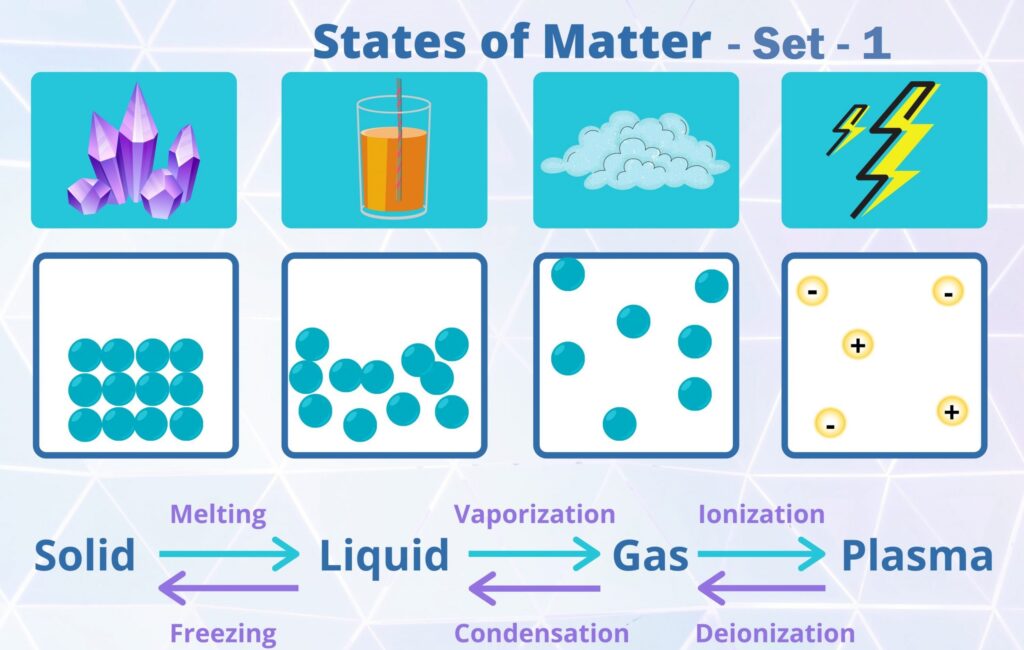
Of the three states of matter, the gaseous state is the simplest and shows greatest uniformity in behaviour. Gases show almost similar behaviour irrespective of their chemical nature. This state is characterized by:
Gases maintain neither the volume nor the shape. They completely fill the container in which they are placed.
They expand appreciably on heating. Gases are highly compressible. The volume of the gas decreases when the pressure increases. They diffuse rapidly into space. Gases exert equal pressure in all directions.
All gases are colourless except a few e.g. chlorine (greenish yellow) bromine (reddish brown), nitrogen dioxide (reddish brown)
The behaviour of gases can be described by certain quantitative relationships called gas laws. They give the relationship between mass, pressure, volume and temperature
Question 5 :
Name the liquid with higher vapour pressure in the following pairs:
(a) Alcohol, Water, Petrol
(b) Petrol, Water, Alcohol
(c) Alcohol, Petrol, Water
(d) None of these
Correct Answer – (C)
The vapour pressure of the liquid is inversely proportional to the magnitude of the intermolecular forces of attraction present. Based on this, the liquid with higher vapour pressure in the different pairs is: (a) Alcohol, (b) Petrol, (c) Water.
MCQ Questions Class 11 Chemistry States of Matter with Answers
Question 6 :
In van der Waal equation of state of gas laws, the constant b is a measure of
(a) Intermolecular collisions per unit volume
(b) Intermolecular attraction
(c) Volume occupied by the molecules
(d) Intermolecular repulsions
Correct Answer – (C)
In van der Waals equation of state of the gas law, the constant b is a measure of the volume occupied by the molecules. It gives the effective size of the gas molecules. The greater value of b indicates a larger size of the molecules and smaller compressible volume.
Question 7 :
The critical volumes of four gases A, B, C, D are respectively 0.025 L, 0.312 L, 0.245 L, 0.432 L, the gas with highest value of van der Wall constant b is
(a) A
(b) B
(c) C
(d) D
Correct Answer – (D)
Vc = 3b = 3 × 4N × (4/3) πr³
Question 8 :
A gas deviates from ideal behavior at a high pressure because its molecules:
(a) Attract one another
(b) Show the Tyndall Effect
(c) Have kinetic energy
(d) Are bound by covalent bonds
Correct Answer – (A)
The basic concept of the kinetic-molecular theory give us the information why real gases deviate from ideal behavior. The molecules of an ideal gas are assumed to occupy no space and have no attractions for one another. Real molecules, however, do have finite volumes, and they do attract one another. So, a gas deviates from ideal behavior at a high pressure because its molecules attract one another
Question 9 :
The rate of diffusion methane is twice that of X. The molecular mass of X is
(a) 64.0
(b) 32.0
(c) 40
(d) 80
Correct Answer – (A)
Question 10 :
The vapour pressure of water at 300 K in a closed container is 0.4 atm. If the volume of container is doubled, its vapour pressure at 300 K will be
(a) 0.8 atm
(b) 0.2 atm
(c) 0.4 atm
(d) 0.6 atm
Correct Answer – (C)
Vapour pressure depends on T only and it does not depend on container volume
- NCERT Solutions Class 11 Chemistry Chapter 1 : Some Basic Concepts of Chemistry
- NCERT Solutions Class 11 Chemistry Chapter 2 : Structure Of The Atom
- NCERT Solutions Class 11 Chemistry Chapter 3 : Classification of Elements and Periodicity in Properties
- NCERT Solutions Class 11 Chemistry Chapter 4 : Chemical Bonding and Molecular Structure
- NCERT Solutions Class 11 Chemistry Chapter 5 : States of Matter
- NCERT Solutions Class 11 Chemistry Chapter 6 : Thermodynamics
- NCERT Solutions Class 11 Chemistry Chapter 7 : Equilibrium
- NCERT Solutions Class 11 Chemistry Chapter 8 : Redox Reactions
- NCERT Solutions Class 11 Chemistry Chapter 9 : Hydrogen
- NCERT Solutions Class 11 Chemistry Chapter 10 : The s-Block Elements
- NCERT Solutions Class 11 Chemistry Chapter 11 : The p-Block Elements
- NCERT Solutions Class 11 Chemistry Chapter 12 : Organic Chemistry: Some Basic Principles and Techniques
- NCERT Solutions Class 11 Chemistry Chapter 13 : Hydrocarbons
- NCERT Solutions Class 11 Chemistry Chapter 14 : Environmental Chemistry