MCQ Class 10 Science Human Eye and Colourful World with Answers

CBSE Class 10 Science Chapter 11 Human Eye and Colourful World Multiple Choice Questions with Answers. MCQ Class 10 Science Human Eye and Colourful World with Answers was Prepared Based on Latest Exam Pattern. Students can solve NCERT Class 10 Science Human Eye and Colourful World MCQs with Answers to know their preparation level.
MCQ Class 10 Science Human Eye and Colourful World with Answers - Set - 3

Question 1: 

The persistence of vision for human eye is
a.  1/10th of a second
b.  1/16th of a second
c.  1/6th of the second
d.  1/18th of a second
Correct Answer – (B)

Question 2 : 

The change in the focal length of human eye is caused due to
a.  Ciliary muscles
b.  Pupil
c.  Cornea
d.  Iris
Correct Answer – (A)

Question 3 : 

Type of lens used in correction of hypermetropia
(a) concave lens
(b) reflecting lens
(c) bifocal lens
(d) convex lens

Correct Answer – (D)

Question 4 : 

Type of lens used in correction of myopia
(a) convex lens
(b) concave lens
(c) reflecting lens
(d) bifocal lens

Correct Answer – (B)

Question 5 : 

Twinkling of stars is due to atmospheric

(a) dispersion of light by water droplets

(b) refraction of light by different layers of varying refractive indices

(c) scattering of light by dust particles

(d) internal reflection of light by clouds.

Correct Answer – (B)

MCQ Class 10 Science Human Eye and Colourful World with Answers

Question 6 : 

The least distance of distinct vision for a young adult with normal vision is
a.  25 m
b.  20 m
c.  25 cm
d.  20 cm
Correct Answer – (C)

Question 7 : 

The image formed by retina of human eye is
a.  Virtual and erect
b.  Real and inverted
c.  Virtual and inverted
d.  Real and erect
Correct Answer – (B)

Question 8 : 

Type of lens used in correction of myopia
(a) convex lens
(b) concave lens
(c) reflecting lens
(d) bifocal lens

Correct Answer – (B)

Question 9 : 

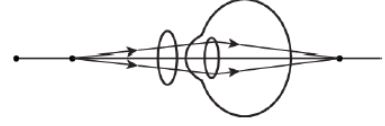
The image shows the ray diagram of a defected eye.

Which option shows the correction of the defect of the eye.

(a)
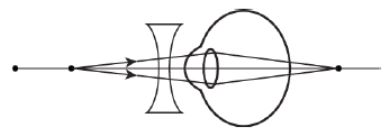
(b)

(c)
(d)

Correct Answer – (D)

Question 10 : 

At noon the sun appears white as

(a) light is least scattered

(b) all the colours of the white light are scattered away

(c) blue colour is scattered the most

(d) red colour is scattered the mos

Correct Answer – (A)

MCQ Class 10 Science Human Eye and Colourful World with Answers

MCQ Class 10 Science Light Reflection and Refraction with Answers

Leave a Reply

Related Post

MCQ Class 10 Science Our Environment with Answers

CBSE Class 10 Science Chapter 15 Our Environment Multiple Choice Questions with Answers. MCQ Class 10 Science Our Environment with Answers was Prepared Based on Latest Exam Pattern. Students can solve NCERT Class 10 Science Our Environment MCQs with Answers to know their preparation level. MCQ Class 10 Science Our Environment with Answers – Set – 6 Question 1: […]

MCQ Questions Class 8 Science Chapter (15)

Class 8 Science MCQ Some Natural Phenomena

Class 8 Science MCQ Some Natural Phenomena with Answers is Prepared Based on Latest Exam Pattern. Students can solve NCERT Class 8 Science MCQ Some Natural Phenomena with Answers to know their preparation level. Students who are searching for NCERT Class 8 Science MCQ Some Natural Phenomena with Answers are compiled here to get good practice on all fundamentals. Know your preparation level […]

MCQ NCERT Class 7 Science Chapter 5 Acids, Bases and Salts

Class 7 Science MCQ Acids, Bases and Salts

Class 7 Science MCQ Acids, Bases and Salts with Answers is Prepared Based on Latest Exam Pattern. Students can solve NCERT Class 7 Science MCQ Acids, Bases and Salts with Answers to know their preparation level. Students who are searching for NCERT Class 7 Science MCQ Acids, Bases and Salts with Answers are compiled here to get good practice on all fundamentals. Know […]