Class 9 Mathematics MCQ Introduction to Euclid’s Geometry Mathematics with Answers is Prepared Based on Latest Exam Pattern. Students can solve NCERT Class 9 Mathematics MCQ Introduction to Euclid’s Geometry Mathematics with Answers to know their preparation level.

Students who are searching for NCERT Class 9 Mathematics MCQ Introduction to Euclid’s Geometry Mathematics with Answers are compiled here to get good practice on all fundamentals. Know your preparation level on MCQ Questions for Class 9 Mathematics MCQ Introduction to Euclid’s Geometry Mathematics with Answers. You can also verify your answers from the provided Class 9 Mathematics MCQ Introduction to Euclid’s Geometry Mathematics with Answers. So, ace up your preparation with MCQ of Class 9 Mathematics MCQ & NCERT Textbook solutions Examinations.
Question : The shape of base of Pyramid is:
(a) Triangle
(b) Square
(c) Rectangle
(d) Any polygon
Answer :(d) Any polygonShow Answer :
Question : The first known proof that ‘the circle is bisected by its diameter’ was given by:
(a) Pythagoras
(b)Thales
(c) Euclid
(d) Hypatia
Answer :(b)ThalesShow Answer :
Question : How many lines do pass through two distinct points?
(a) 1
(b) 2
(c) 3
(d) 4
Answer :(a) 1Show Answer :
Question : The things which are double of same things are:
(a) halves of same thing
(b) double of the same thing
(c) Equal
(d) Unequal
Answer :(c) EqualShow Answer :
Question : If a > b and b > c, then,
(a) a = c
(b) a < c (iii) a > c
(d) a ≤ c
Answer :(c) a > cShow Answer :
Question : Three or more lines are called concurrent lines if they pass through …….. point.
(a) Two
(b) Three
(c) Same
(d) None of these
Answer :(c) SameShow Answer :
Question : Greeks emphasized on:
(a) Public worship
(b) Household rituals
(c) Both (i) and (ii)
(d) None of (i), (ii) and (iii)
Answer :(a) Public worshipShow Answer :
Question : The things which coincide with one another are:
(a) equal
(b) unequal
(c) half of same thing
(d) triple of one another
Answer :(a) equalShow Answer :
Question : Lines are parallel if they do not intersect’ – is stated in the form of:
(a) A postulate
(b) An axiom
(c) A definition
(d) A proof
Answer :(a) A postulateShow Answer :
Question : The sum of two numbers is 8 and the sum of their reciprocals is 8/15. Find the numbers.
(a) 5, 3
(b) 7, 1
(c) 4, 4
(d) 2, 6
Answer :AShow Answer :
Question : The sum of the digits of a two-digit number is 12. The number obtained by interchanging the two digits exceeds the given number by 18. Find the number.
(a) 57
(b) 75
(c) 85
(d) 58
Answer :AShow Answer :
Question : The denominator of a rational number is greater than its numerator by 3. If 3 is subtracted from the numerator and 2 is added to the denominator, the new number becomes 1/5 . Then the original number was _______.
(a) 7/11
(b) 3/5
(c) 5/8
(d) 4/7
Answer :CShow Answer :
Question : If am = bl and bn ≠ cm, then the system of equations
ax + by = c
lx + my = n
(a) Has a unique solution.
(b) Has no solution.
(c) Has infinitely many solutions.
(d) May or may not have a solution.
Answer :BShow Answer :
Question : The value of k, for which the system of equations kx – 3y + 6 = 0, 4x – 6y + 15 = 0 represent parallel lines, is _______.
(a) 1
(b) 2
(c) 3
(d) 4
Answer :BShow Answer :
Question : If the system of equations
2x + 3y = 7
2ax + (a + b)y = 28
has infinitely many solutions, then the values of a and b respectively are _______.
(a) 2, 5
(b) 5, 8
(c) 4, 8
(d) 3, 6
Answer :CShow Answer :
Question : In a ΔABC, ∠C = 3∠B = 2(∠A + ∠B). The three angles will be _______.
(a) 20°, 40°, 120°
(b) 30°, 60°, 90°
(c) 45°, 45°, 90°
(d) 90°, 40°, 50°
Answer :AShow Answer :
Question : ax + by + c = 0 does not represent an equation of line when _______.
(a) a = c = 0, b ≠ 0
(b) b = c = 0, a ≠ 0
(c) a = b = 0
(d) a = b ≠ 0
Answer :CShow Answer :
Question : The ratio of a 2-digit number to the sum of digits of that number is 4 : 1. If the digit in the unit place is 3 more than the digit in the tens place, what is the number ?
(a) 63
(b) 36
(c) 24
(d) 40
Answer :BShow Answer :
Question : How many values of c, for which the systemof equations 6x + 3y = c – 3, 12x + cy = c has infinitely many solutions?
(a) 1
(b) 2
(c) 3
(d) Infinite
Answer :AShow Answer :
Question : Sum of two numbers is 64 and their difference is 22. Find the numbers.
(a) 42, 22
(b) 43, 21
(c) 40, 24
(d) 50, 28
Answer :BShow Answer :
Question : If a pair of linear equations in two variablesis consistent, then the lines represented by two equations are
(a) Always intersecting
(b) Parallel
(c) Always coincident
(d) Intersecting or coincident
Answer 😀Show Answer :
Question : The solution of the system of equations 2x 5y/xy = and 4x – 5y/xy+ 3=0 (where x ≠ 0, y ≠ 0), is _______.
(a) 1, 2
(b) 0, 0
(c) –1, 2
(d) 1, –2
Answer :AShow Answer :
Question : Value of x in pair of linear equations 36x + 24y = 702 and 24x + 36y = 558 is
(a) 33/2
(b) 145/7
(c) 16
(d) 17
Answer :AShow Answer :
Question : Which of the following linear equation coincide with the line 4x + 5y = 15?
(a) 8x + 10y = 25
(b) 2x + 3y = 7
(c) 7x + 14y = 17
(d) 12x + 15y = 45
Answer 😀Show Answer :
Question : Arun and Prabhat have some books with them. Once Prabhat said to Arun that, if Arun gives 3 books to Prabhat then Arun will have only 1/2 of the books that Prabhat will have with him. Then Arun asked frankly that if Prabhat gives him only two books (to Arun), then Prabhat will have as many books as Arun will have. The total number of books that Arun and Prabhat have with them is _______.
(a) 25
(b) 56
(c) 30
(d) Can’t be determined
Answer :CShow Answer :
Question : Places M and N are 90 km apart from each other on a national highway. A truck starts from M and another from N at the same time. If they go in the same direction, then they meet in 9 hours and if they go in opposite directions they meet in 9/7 hours. The speed of the trucks are _______.
(a) 90 km/hr, 40 km/hr
(b) 40 km/hr, 30 km/hr
(c) 20 km/hr, 60 km/hr
(d) 50 km/hr, 12 km/hr
Answer :BShow Answer :
Question : A boat goes 32 km upstream and 36 km downstream in 7 hours. In 9 hours, it can go 40 km upstream and 48 km downstream. If x represents the speed of the boat in still water in km/hr and y represents the speed of the stream in km/hr, then_______.
(a) x + y = 12, x – y = 8
(b) x + y = 5, x – y = 11
(c) x + y = 6, x – y = 10
(d) x + y = 10, x – y = 6
Answer :AShow Answer :
Question : At the end of the year 2002, Ram was half as old as his grandpa. The sum of the years in which they were born is 3854. Age of Ram at the end of year 2003 is _______.
(a) 50 years
(b) 35 years
(c) 51 years
(d) 36 years
Answer :CShow Answer :
Question : On selling a tea-set at 5% loss and lemonset at 15% gain, a crockery seller gains ₹ 7. If he sells the tea-set at 5% gain and the lemon-set at 10% gain, he gains ` 13. Find the actual prices of the tea-set and the lemon-set.
(a) ₹ 100, ₹ 80
(b) ₹ 90, ₹ 100
(c) ₹ 120, ₹ 60
(d) ₹ 150, ₹ 80
Answer :AShow Answer :
Question : Solve for x and y in the following question.

(A) x = 1, y = 2
(b) x = 2, y = 1
(c) x = 2 y = 1/2
(d) x = 1/2 y = 2
Answer 😀Show Answer :
Question : Match the following.System of equations Solutions
(P) 2x – 3y + 15 = 0 (i) x = 3, y = 5
3x – 5 = 0
(Q) 2x – y = 1 (ii) x = 1, y = 4
4x + 3y = 27
(R) x + 2y – 3 = 0 (iii) x = 5/3 y = 55/9
3x – 2y + 7 = 0
(S) 4x + y/3 = 16/3 (iv) x =– 1,y = 2
x/2 + 2y/4 = 5/2
(a) (P) → (iii); (Q) → (iv); (R) → (i); (S) → (ii)
(b) (P) → (iii); (Q) → (i); (R) → (iv); (S) → (ii)
(c) (P) → (iii); (Q) → (ii); (R) → (iv); (S) → (i)
(d) (P) → (ii); (Q) → (i); (R) → (iv); (S) → (iii)
Answer :BShow Answer :
Question :Which of the following graphs represent the lines 2x + 4y = 8 and 3x – 4y = 12 ?
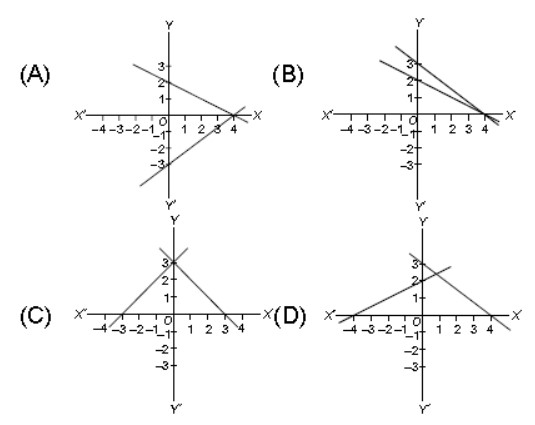
Answer :AShow Answer :
Question :Fill in the blanks.
(i) If pair of linear equations is consistent, then it has either P or Q solution(s).
(b) If the pair of linear equation is inconsistent, then it has R solution(s).
(c) If the graph of two linear equations coincide, then they have S solution(s).
P Q R S
(a) no infinite unique infinite
(b) unique infinite no infinite
(c) no infinite unique unique
(d) unique no infinite no
Answer :BShow Answer :
Question : Read the statements carefully and state ‘T’ for true and ‘F’ for false.
(i) The pair of linear equations x + 2y = 5 and 7x + 3y = 13 has unique solution x = 2, y = 1.
(b) √2x + √3y = 0, √3x − √8y = 0 has no solution.
(c) The values of p and q for which the following system of equations 2x – y = 5, (p + q)x + (2p – q)y = 15 has infinite number of solutions, is p = 1 and q = 5.
(i) (ii) (iii)
(a) T F T
(b) T T F
(c) F T T
(d) F F T
Answer 😀Show Answer :
Question : A solid has __________dimensions.
(a) One
(b) Two
(c) Three
(d) Zero
Answer : cShow Answer :
Explanation: A solid is a three-dimensional object.
Question : A point has _______ dimension.
(a) One
(b) Two
(c) Three
(d) Zero
Answer : dShow Answer :
Explanation: A point is always dimensionless.
Question : The shape of the base of a Pyramid is:
(a) Triangle
(b) Square
(c) Rectangle
(d) Any polygon
Answer : dShow Answer :
Explanation: A pyramid base could have any polygon shape.
Question : The line drawn from the center of the circle to any point on its circumference is called:
(a) Radius
(b) Diameter
(c) Sector
(d) Arc
Answer : aShow Answer :
Question : There are ________ number of Euclid’s Postulates
(a) Three
(b) Four
(c) Five
(d) Six
Answer : cShow Answer :
Question : Euclid’s fifth postulate is
(a) The whole is greater than the part
(b) All right angles are equal to one another.
(c) If a straight line falling on two straight lines makes the interior angles on the same
side of it taken together less than two right angles, then the two straight lines if
produced indefinitely, meet on that side on which the sum of angles is less than two
right angles
(d) A circle may be described with any centre and any radius
Answer :cShow Answer :
Explanation: Euclid’s fifth postulate is If a straight line falling on two straight lines makes the interior angles on the same side of it taken together less than two right angles, then the two straight lines if produced indefinitely, meet on that side on which the sum of angles is less than two right angles.
Question : The three steps from solids to points are:
(a) Lines – points – surfaces – solids
(b) Lines – surfaces – points – solids
(c) Solids – lines – surfaces – points
(d) Solids – surfaces – linepoint
Answer :dShow Answer :
Explanation: The three steps from solids to points are Solids to surfaces and surfaces to line points.
Question : The boundaries of solid are called:
(a) Surfaces
(b) Curves
(c) Lines
(d) Points
Answer : aShow Answer :
Question : A surface of shape has:
(a) Length, breadth and thickness
(b) Length and breadth only
(c) Length and thickness only
(d) Breadth and thickness only
Answer : bShow Answer :
Question : The edges of the surface are :
(a) Points
(b) Curves
(c) Lines
(d) None of the above
Answer : cShow Answer :
Question : Which of these statements do not satisfy Euclid’s axiom?
(a) Things which are equal to the same thing are equal to one another
(b) If equals are added to equals, the wholes are equal.
(c) If equals are subtracted from equals, the remainders are equal.
(d) The whole is lesser than the part.
Answer : dShow Answer :
Question : Which of the following statements are true?
(a) Only one line can pass through a single point.
(b) There is an infinite number of lines that pass through two distinct points.
(c) A terminated line can be produced indefinitely on both sides
(d) If two circles are equal, then their radii are unequal.
Answer : cShow Answer :
Question : Axioms are assumed
(a) Theorems
(b) Definitions
(c) Universal truths specific to geometry
(d) Universal truths in all branches of mathematics
Answer :dShow Answer :
Explanation: Axioms are assumed universal truths in all branches of mathematics and no mathematical deduction is needed to prove them.
Question : The things which are double of the same thing are
(a) equal
(b) unequal
(c) double of the same thing
(d) halves of the same thing
Answer :aShow Answer :
Explanation: The things which are double of the same thing are equal. According to the Euclidian axiom, the things which are double the same thing are equal to each other. For example, if 2a = 2b, then a =b.